





RADAR
- Home
- RADAR
RADAR
Advanced PCB Solutions for High-Frequency Radar Applications
At the forefront of advanced electronics, radar systems are no longer confined to military or aerospace applications. From automotive safety to industrial automation and smart city infrastructure, the demand for high-performance, cost-effective radar has exploded. As a PCB solutions provider, we understand that the printed circuit board is the fundamental building block of any radar system. Its design and fabrication are critical to achieving the required performance, especially given the extremely high frequencies at which these systems operate.
The Challenge of High-Frequency RF
Radar systems typically operate at frequencies ranging from a few gigahertz (GHz) to as high as 77 GHz and beyond. At these frequencies, standard FR-4 materials are no longer sufficient. Their high dielectric loss can significantly attenuate the RF signal, leading to a loss in radar range and sensitivity. We use low-loss, high-frequency laminates from Rogers, Taconic, and other high-performance materials with stable dielectric constants and low dissipation factors to ensure minimal signal loss and consistent performance.
Integrated Antenna Design
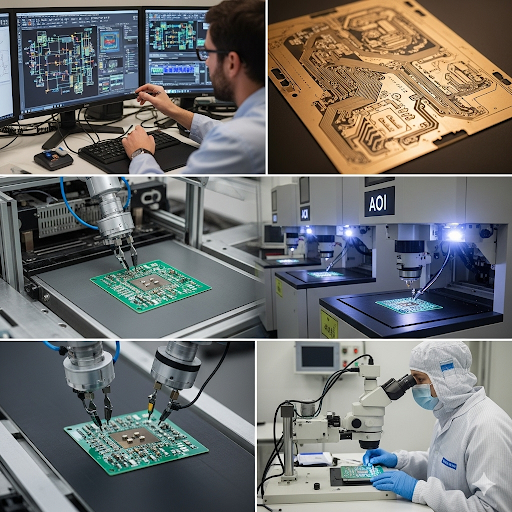
Many modern radar systems feature an integrated antenna directly on the PCB. This requires tight control over fabrication tolerances. We use advanced lithography and etching processes to achieve micron-level accuracy, ensuring optimal antenna performance and collaborating with clients to apply DFM rules for best results.
Signal Integrity and Impedance Control
- Controlled Impedance Traces: Precise control of trace width, thickness, and ground plane spacing for consistent impedance (50 ohms typical).
- Layer Stack-up Optimization: Alternating signal and ground planes for shielding and minimal crosstalk.
- HDI Technology: Microvias and blind/buried vias for shorter signal paths, reduced inductance, and improved signal quality.
Thermal and Mechanical Reliability
Radar modules often generate significant heat. We use:
- Insulated Metal Substrate (IMS) PCBs: For high-power RF applications.
- Heavy Copper PCBs: To dissipate heat efficiently and maintain component reliability.
Our PCBs withstand vibration, shock, and extreme temperatures, meeting IATF 16949 standards for automotive and safety-critical sectors.